What is E.V.A.
E.V.A. stands for Ethylene Vinyl Acetate, a thermoplastic copolymer that combines the characteristics of ethylene and vinyl acetate. In everyday terms, it’s a rubber-like material: soft to the touch, resilient, and lightweight. Unlike traditional plastics, E.V.A. offers:
- Elastic rebound: it absorbs impact and returns to its original shape.
- Low specific weight: enables lightweight soles without sacrificing comfort.
- Insulation: good thermal and acoustic insulation properties.
- Processability: it expands, can be cut, thermoformed, and injected with great precision.
- Waterproof, hypoallergenic, and antibacterial thanks to its closed-cell structure.
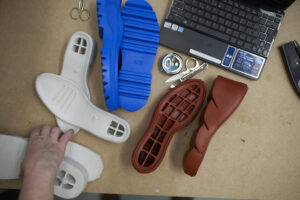
At Selasti, we design the mix starting from virgin granules to develop different compounds based on customer requests and needs. We monitor every stage — including sheet printing and injection—to adjust hardness, density, and grip according to customer specifications.
E.V.A. vs PVC/Rubber/PU: differences that matter in footwear
When should you choose E.V.A. over other materials? It depends on the project. Here’s a quick, non-exhaustive comparison:
- E.V.A. → Leggerezza, comfort e assorbimento urti; grip e resistenza all’abrasione ottimi e modulabili tramite densità e durezza (Shore); grande libertà estetica (colori, finiture, texture). Ideale per sneakers, sandali e ciabatte, calzature da lavoro leggere, tempo libero e linee bimbo.
- Rubber → Extreme grip and very high abrasion resistance in harsh conditions; generally heavier. Excellent for technical outdoor and high mechanical-stress scenarios.
- PVC → Più rigido e economico; meno confortevole a parità di spessore. Usato in segmenti price-sensitive o per componenti specifiche.
- PU (polyurethane) → Good support and resistance; variable density; can feel less soft than some E.V.A. formulations.
In practice: if you need comfort, low weight, and adjustable performance (including grip/abrasion), E.V.A. is often the most versatile choice.

Technical properties: what to expect from a good E.V.A. Proprietà tecniche: cosa puoi aspettarti da una buona E.V.A.
Formulation makes all the difference. With our integrated supply chain we tailor the material to its end use:
- Shore A/C hardness and density on demand for the right balance of comfort, support, and durability — also suitable for orthopedic applications.
- Impact absorption & resilience for smoother gait and reduced fatigue.
- Dimensional stability and shape memory to retain form.
- Thermal insulation: greater protection from ground heat/cold.
- Moisture resistance: closed-cell structure → buoyancy and low water uptake, which makes it antibacterial.
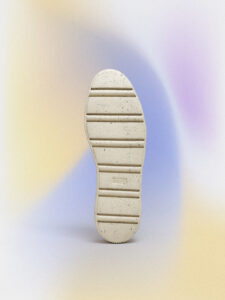
- Aesthetics: solid colors, bicolor and marbled effects, multi-material inclusions, textures, and special finishes.
On request, we add technical-functional packages and optimize performance in sheet molding/injection/thermoforming for your production cycle.
Additives and optimizations
L’E.V.A. è naturalmente resistente all’abrasione e presenta un comportamento igienico favorevole (la bassa assorbenza e la superficie a cella chiusa è poco ospitale per i batteri). Gli additivi servono quindi per adattarla a condizioni ambientali o d’uso specifiche, ad esempio:
- High-temperature stability.
- Retention of flexibility and elasticity in the cold.
- UV protection (color hold and long-term properties).
- Project-specific resistances (e.g., water/oil-repellent surface coating, antistatic properties), when relevant to sector standards.
Depending on Shore hardness, density, and process (sheets/thermoforming or injection), we design the compound to balance comfort, durability, and compliance requirements without introducing unnecessary additives.
Safety, compliance, sustainability: beyond the material
Designing a sole today also means responsibility. Our approach includes:
- Recycled: use of pre-consumer recycled E.V.A. in controlled blends to reduce virgin material, with testing on performance and stability over time.
- Bio-based: granules with biogenic content (from renewable sources such as sugarcane), with support on recognized methods to measure bio content.
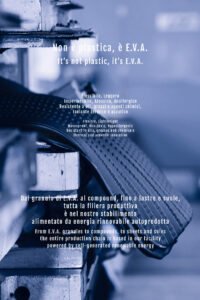
- Solar energy: a significant share of the energy used in our plant is self-generated by a photovoltaic system.
- Certifications: support in compiling technical documentation and, where applicable, navigating standards and certification schemes.
Nota utile per i brand: evitiamo greenwashing. Se comunichi “riciclato” o “bio-based”, ti aiutiamo a usare terminologia corretta, metodiche riconosciute, certificazioni e dati verificabili.
Where E.V.A. excels (typical use cases)
- Lifestyle and sport
- Work and light-safety footwear: soles with excellent rebound and insulation.
- Medical and comfort materials with support for regulatory requirements: insoles, footwear for prolonged use.
- Kids: lightness + colors for safe, comfortable soles with playful design.
- Furniture, outdoor, and marine
How to choose your E.V.A.: a quick checklist
- Use context urban, outdoor, safety, healthcare?
- Desired feel: softer or more supportive?
- Weight targets and thicknesses.
- Grip & abrasion requirements (standards/regulations).
- Aesthetic constraints: colors, textures, special effects.
- Process constraints: do you prefer sheets for cutting/thermoforming or injection ?
- ESG/communication needs: recycled/bio-based percentages, documentation.
With these inputs we define compound, density, and hardness, and recommend sheets or injection based on volumes, costs, and expected performance.
F.A.Q
Is E.V.A. plastic?
It’s a thermoplastic copolymer with elastomeric behavior. In practice: it isn’t the rigid “plastic” you’re thinking of, but a soft, flexible, resilient material.
Is E.V.A. toxic?
Our formulations are designed for footwear and related components, with careful controls against applicable regulatory requirements. We provide technical data sheets and compliance support.
Can E.V.A. be recycled? In many cases yes, especially pre-consumer. For finished soles it depends on the structure (e.g., inserts, bonding). With G. Side® we reuse over 60% of E.V.A. recovered from processing.
Is E.V.A. bio-based?
Yes, it is made with plant-based carbon, and the biogenic content can reach very high percentages (up to ~85%). With the FOOD WASTE filler, we further increase the biogenic content of the compound to 95% and certify the final product (TÜV AUSTRIA).